
A practical guide to choosing the Greek destination that fits your holiday — not simply the one that looks best on Instagram
Ask ten people which Greek island is the most beautiful and you will probably get ten different answers. That is exactly why I never start there.
After years of planning villa holidays in Greece, I have learned that the right destination is rarely about finding the “best” island. It is about finding the island – or mainland destination
A couple travelling for four nights in October should not necessarily receive the same recommendation as three families travelling for a week in August. A spectacular beach is not very useful if reaching it turns a short holiday into a logistical project. And a direct flight is not automatically the easiest option if the villa is another two and a half hours from the airport.
So before choosing a villa, I ask four questions.
1. When are you travelling?
In Greece, the month changes much more than the temperature. It affects the sea, the wind, crowds, ferry schedules, restaurant openings, villa availability and price. Choosing the right island starts with understanding what Greece feels like at that particular time of year.
May: choose the holiday, not just the sunshine
May can be wonderful in Greece, especially if you want to explore rather than spend every day in the sea. Crete and Rhodes are often among my first choices because their southern position gives them a longer season and both have enough depth to make a cooler or cloudier day irrelevant: old towns, villages, food, archaeological sites, landscapes and excellent day trips.
Corfu and Kefalonia are particularly beautiful and green in spring, but I would be more cautious if the brief is simply “warm sea, pool and beach every day”. May is still the beginning of the season, especially in the Ionian and Cycladic islands, and some seasonal services may not yet be operating at full summer pace.
YAMAS tip — May and price
May can offer excellent value, but price should never be viewed in isolation. A cheaper villa is not necessarily better value if the restaurants, boat services or beach facilities you wanted are not yet operating nearby.
June: one of Greece’s best all-round months
June is when the map really opens. The weather is much more reliably summery, the sea is warming, most seasonal businesses are open and the islands generally feel less intense than they do in July and August.
Alongside Crete, Rhodes, Corfu, Kefalonia and the Peloponnese, I start looking seriously at Milos, Paros, Naxos, Lefkada, Zakynthos, Skiathos and Mykonos.
YAMAS tip — June and availability
June often gives a very good balance of weather, choice and cost. But the exceptional villas — beachfront homes, large villas and properties with several true master bedrooms — can already be heavily booked.
July and August: almost everywhere works — which is exactly the problem
In high summer, almost the whole Greek map is available. The question is no longer “where is warm enough?” but “what kind of holiday do you want?”
If beaches are the main event, I would look closely at Lefkada, Kefalonia, Zakynthos, Naxos, Milos and Skiathos. If you want style, restaurants and energy, Paros, Mykonos, Santorini and Ios enter the conversation. For families, Crete, Rhodes, Kefalonia, Naxos, Lefkada and Halkidiki are consistently strong options.
There is another factor in the Cyclades: the meltemi, the seasonal northerly Aegean wind. It can be wonderfully cooling on a hot day, but it can also affect beach comfort, sailing plans and ferry conditions. If a private boat day is one of the highlights of your holiday, build in some flexibility.
YAMAS tip — August is about availability, not only price
Waiting until the last minute does not simply mean paying more. It often means losing the villas that genuinely suit your group. For large families or several families travelling together, I would start much earlier.
September: the YAMAS sweet spot
September is one of my favourite months in Greece. The sea has had all summer to warm up, the crowds begin to ease and the overall rhythm becomes calmer. Crete, Rhodes, Kefalonia, Corfu, Lefkada, Zakynthos, Paros, Naxos, Milos, Skiathos and the Peloponnese can all work beautifully.
It is particularly good for travellers who want both the sea and the freedom to explore without peak-summer intensity.
YAMAS tip — September and value
This is often one of the best balances between warm water, atmosphere, availability and price. For many travellers, September gives a more relaxed version of the same Greek summer.
October: start south
By October I become more selective. If you still want the possibility of a summer-style holiday, I start with Crete and Rhodes. Santorini can be excellent when views, food and atmosphere matter more than swimming every day, while the Peloponnese is a strong option for road trips, towns, food and nature.
The important point is not to choose an October holiday as though it were August. Choose a destination that still gives you plenty to enjoy if one day is not a beach day.
November to April: stop trying to force an island holiday
This is when Athens and Thessaloniki move to the front of the list. Crete and the Peloponnese can still be excellent for food, culture, walking and road trips, but I would not sell this period as a classic Greek island summer.
2. How much journey are you willing to make?
This is one of the most underestimated questions in planning a Greek holiday. The destination that looks closest on a map is not always the easiest to reach, and “direct flight” does not necessarily mean “quick arrival at the villa”.
Option A: I only want a direct flight
Seasonal direct routes from Israel can make destinations such as Athens, Thessaloniki, Crete, Rhodes, Corfu, Kefalonia, Mykonos, Santorini and Karpathos especially attractive, depending on the exact travel dates.
But I always calculate the journey from aircraft door to villa door. Crete is the perfect example: it is a direct-flight destination, but Heraklion and Chania are roughly two hours apart by road. A villa on the opposite side of a large island can turn a “simple” flight into a long transfer.
The same principle applies in Rhodes, Corfu and Kefalonia. Before celebrating the direct flight, check where the villa actually is.
YAMAS tip — The real journey time
For a four-night holiday, I give transfer time much more weight than I do for a ten-night holiday. One extra hour each way matters when the entire trip is short.
Option B: Athens + a domestic flight
This is the option that opens up islands many travellers dismiss too quickly. Paros, Naxos and Milos can be reached by domestic air from Athens, allowing you to avoid the trip to Piraeus and a ferry crossing.
The key is to look at the entire connection, not just the 40-minute domestic flight. Check the connection time, baggage arrangements and whether the flights are on one ticket or two separate bookings. With separate tickets, I always leave a more generous buffer.
For a week-long holiday, that extra connection can be completely worthwhile if it gets you to the destination that suits you best. For three or four nights, I calculate the waiting time much more carefully.
YAMAS tip — Do not reject an island because there is no direct flight
Sometimes a short domestic connection from Athens produces a total journey time that is surprisingly similar to a long road transfer after a direct flight.
Option C: flight + car
This is where a completely different Greece opens up.
Halkidiki
Fly to Thessaloniki and continue by car. The beginning of Sithonia is roughly 75–90 minutes from the airport, while the southern end can approach two hours. It is an excellent choice for families and travellers who want beaches, resorts and straightforward holiday infrastructure without taking a ferry.
Pelion
Pelion also works via Thessaloniki, but the experience could not be more different. Volos is roughly two and a half hours away, and from there the drive depends on the village you choose. Eastern Pelion can involve longer, winding mountain roads.
I recommend Pelion to travellers who see the journey as part of the experience: stone villages, mountain scenery, excellent food, green landscapes and beautiful beaches — sometimes all in the same day.
Lefkada
Lefkada is unusual because it is an island connected to mainland Greece by a bridge. When flights to nearby Preveza/Aktion work with your dates, you can land, collect a car and drive to the island without taking a ferry. For groups planning a villa-and-sailing holiday, this can be a major advantage.
Peloponnese and Evia
In the Peloponnese, access depends enormously on the exact area. Nafplio is relatively easy from Athens, while the southern and western Peloponnese require more driving. Evia is another destination people sometimes overlook because parts of the island are surprisingly accessible from Athens by road and bridge.
YAMAS tip — Two hours are not always two hours
Two hours on a motorway are not the same as two hours on winding mountain roads. When I recommend Pelion, for example, I explain the character of the drive as well as its duration.
Option D: flight + ferry
A ferry is not automatically a complication. Sometimes it is the step that gets you to a quieter, more interesting or more suitable island.
Ios
One natural route is via Santorini, followed by a ferry to Ios. It works well for travellers looking for Cycladic scenery, beaches and a younger, livelier atmosphere.
Kea
Kea’s great advantage is its proximity to Athens. Travel to the port of Lavrio and continue by ferry. It can be a very good choice for couples or families who want a calmer Cycladic island without travelling deep into the Aegean.
Thassos
Thassos requires more commitment: reach northern Greece, drive towards Kavala or Keramoti and continue by ferry. It would not be my first recommendation for a very short holiday where minimum logistics are the priority, but it rewards travellers looking for a green northern island and a different Greek experience.
Paros, Naxos and Milos
These islands give you a choice: domestic flight or ferry from Athens. If you are planning an island-hopping holiday, the ferry can stop feeling like a disadvantage and become part of the trip.
YAMAS tip — Never book the ferry in isolation
Look at the entire chain: airport arrival, baggage collection, transfer to the port, a realistic safety margin, ferry departure and the final transfer on the island. The last ferry of the day matters much more than the theoretical crossing time.
3. Who is travelling?
Couples
Santorini is hard to beat when the brief is romance, dramatic views and memorable dinners. Milos is stronger when unusual beaches and landscapes are central. Paros gives a softer balance of beaches, restaurants and style. Kea and Karpathos are interesting alternatives for couples who want something less obvious.
Families
Crete and Rhodes are excellent when you need variety and enough to fill a full week. Naxos combines long beaches with villages and good food. Kefalonia and Lefkada work well for families who enjoy driving, exploring and being on the water. Halkidiki is particularly useful when easy beach access and resort-style infrastructure matter.
YAMAS tip — For large families, the island is only half the decision
I look at the villa almost as carefully as the destination: how many genuine master bedrooms there are, who shares with whom, whether several cars are needed, and how far the house is from beaches, restaurants and supermarkets.
Friends
Lefkada and Kefalonia are excellent when the dream is a beautiful villa, days on the water and a boat. Paros and Mykonos move up the list when restaurants and nightlife matter. Crete and Rhodes are better for groups that want more variety than beach by day and dinner by night.
4. What do you actually want to do?
If the beaches are the reason for the trip
Milos is for travellers who want beaches and geological landscapes that genuinely feel different. A boat trip around the island adds another dimension.
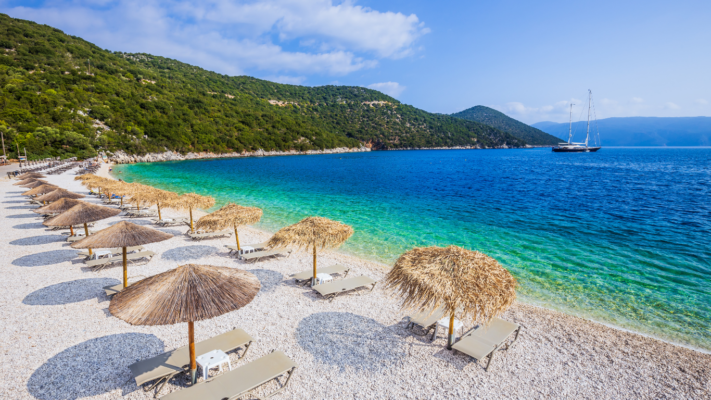
Lefkada is about turquoise water, dramatic beaches and sailing. It is especially good for groups or families who want to hire a boat and explore the surrounding islets and bays.
Kefalonia is more than one famous beach. It combines organised family-friendly beaches, coves for snorkelling and more remote stretches of coast with Fiskardo, Assos, Melissani Cave and beautiful driving routes.
Naxos is excellent for families who want long beaches but also villages, food and enough variety for a week. Zakynthos is particularly strong when sea caves, boat trips and dramatic coastal scenery are central to the holiday.
If you want to discover Greece, not just lie beside it
Crete is the broadest choice: beaches, cities, villages, gorges, wineries, food and history. The mistake is trying to see the entire island. Choose the right region first and build day trips from there.
Corfu and Kefalonia show a greener side of Greece than the Cyclades. Driving, villages and scenery are part of the experience. Corfu adds a beautiful old town with strong Venetian influence, while Kefalonia combines nature with small harbour villages.
Pelion and the Peloponnese are excellent reminders that the perfect Greek holiday does not have to be on an island. Pelion gives you mountains and sea in the same trip; the Peloponnese combines road-trip freedom, historic sites, towns, beaches and food.
And Athens and Thessaloniki should not be treated only as gateways. Athens can combine culture, food and the Athenian Riviera; Thessaloniki is one of Greece’s great food cities and an excellent starting point for northern Greece and Halkidiki.
A quick YAMAS cheat sheet
Crete — The most versatile choice for families, couples, food, touring and beaches
Halkidiki — Beaches and resorts with a road transfer from Thessaloniki
Peloponnese — Road trips, towns, history and beaches
Corfu — Green, elegant, village life and a beautiful old town
Kefalonia — Dramatic beaches, nature and harbour villages
Rhodes — Long season, families, beaches and history
Paros — Relaxed style, restaurants, beaches, couples and friends
Lefkada — Sea and sailing with the advantage of a bridge to the mainland
Evia — A less obvious Greece with surprisingly convenient access from Athens
Pelion — Mountain and sea, villages, nature and a journey that is part of the holiday
Zakynthos — Sea, caves, boat trips and a classic summer holiday
Skiathos — Green scenery, beaches and a compact island
Karpathos — Local character and beaches for travellers wanting something less obvious
Thassos — A green northern island worth the extra journey
Kea — A calmer Cycladic option relatively close to Athens
Naxos — Families, beaches, villages and food
Milos — Extraordinary geology and distinctive beaches
Santorini — Views, romance and food rather than a classic beach holiday
Ios — Beaches and youthful energy, usually reached by ferry
Mykonos — Style, restaurants, nightlife and beaches
Athens — Food, culture and the Riviera all year round
Thessaloniki — Food, city life and a gateway to northern Greece
What would I choose for you?
Five nights in June, a family, no ferry, and you want to explore as well as swim
Crete or Rhodes
Both let you build a full holiday from one base without every day revolving around the beach
A week in September, a couple who already knows Greece and wants exceptional beaches
Milos or Kefalonia
Milos for geological wow-factor and sailing; Kefalonia for beaches combined with villages and scenic drives
Three families in August who want a villa, a boat and lots of sea
Lefkada or Kefalonia
Both work beautifully when the villa and the water are the heart of the holiday
A couple in October who still wants to feel summer
Crete or Rhodes
I start in the south and choose somewhere with enough to do even if one day is not perfect for the beach
Four nights with friends, restaurants, beaches and going out
Mykonos or Paros
Mykonos when access and energy are the priority; Paros for a softer balance
A week with children but you do not necessarily want an island
Halkidiki or Pelion
Halkidiki for convenience and beaches; Pelion for a family that loves nature, villages and exploring
Winter, a couple, food and culture
Athens or Thessaloniki
In winter I stop trying to force an island holiday and embrace a Greek city break
The final decision
If you finish these four questions with two strong destinations still on the table, that is exactly where the real planning begins. Now I look at the details that change a good holiday into the right holiday: where the villa sits within the destination, the real transfer time from the airport, the nearest beach, whether a car is essential, how the bedrooms work for the group and what is actually open during your dates.
That is also why I do not believe in choosing a villa first and then trying to make the destination fit around it. The holiday starts with the people.